Angela Perfect Valentine
Popular Games
Last Played
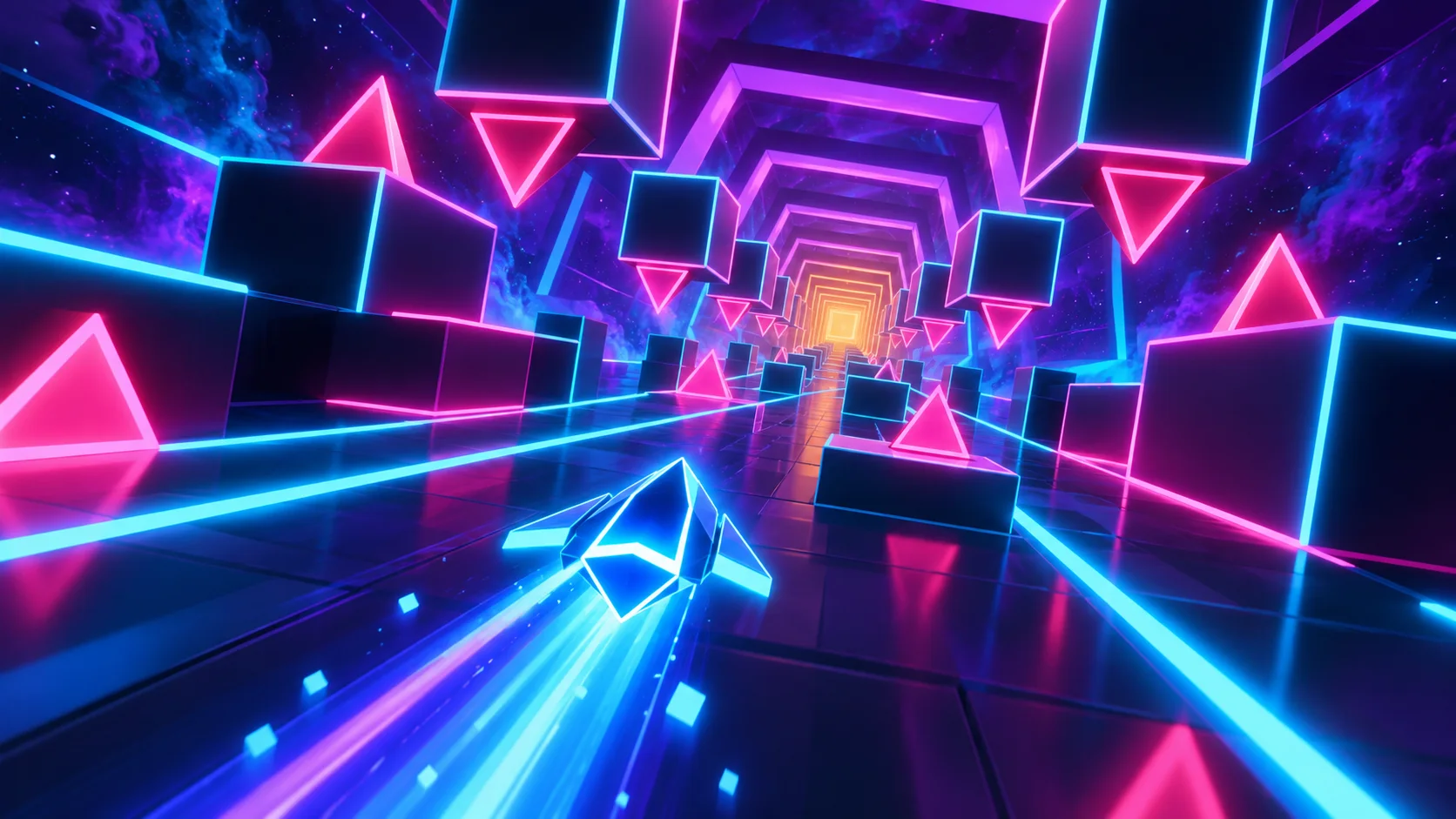
Geometry Vibes 3D takes the familiar Geometry Vibes idea into a three-dimensional presentation. The confirmed listing describes reimagined levels, obstacles, reflex-based movement, rhythm, arrow-key input, and options for one or two players. Those facts create a clear first impression: movement must be read quickly while depth and perspective change how the next obstacle appears. This short magazine-style look stays with that visible structure and leaves level count, scoring, speed changes, and other unverified systems to the live game.
In a flat scene, distance can often be estimated from horizontal spacing alone. A 3D view adds another cue: an object may appear small because it is far away, then expand as the route approaches it. Strong contrast between the route, the controlled shape, and the next hazard helps the player understand that change before reacting.
Perspective can make the scene feel faster even when the underlying pace is unchanged. For that reason, the nearest obstacle should remain easy to identify among decorative forms farther into the background. The live version shows how each stage handles this hierarchy; the description does not justify a claim about a particular camera angle or transition.
The listing connects reflexes with rhythm. Repeated visual spacing can establish an expectation, while a different gap or height can interrupt it. A useful approach is to observe one short sequence before assuming that every obstacle follows the same interval. The exact relationship between music, animation, and input is not confirmed, so this article does not turn rhythm into an undocumented timing rule.
The tags indicate both one-player and two-player play. That suggests the interface may need to communicate more than one active input in some mode, but the listing does not explain how the screen is divided or how a second participant joins. Current menu labels and on-screen prompts are the reliable guide.
Arrow keys are confirmed, yet additional controls are not. Start by checking the active instructions, then use the visual response of the controlled form to understand how long an input should be held. A clean restart cue is also useful after a collision, although its exact location belongs to the running game.
Geometry Vibes 3D is easiest to understand as a conversation between depth, obstacle spacing, and timely movement. Open Geometry Vibes 3D for the current modes and controls, or browse Arcade Games for more compact challenges. Watch the nearest route, use rhythm as context rather than a guarantee, and let each level reveal its own pattern before committing to the next move.
The 3D direction gives familiar geometric forms a stronger sense of approach. Good readability comes from knowing what is close, what is decorative, and which movement cue matters now. That is the practical core of the game without adding unsupported rewards, characters, or progression.