Hummer Jeep Driving Sim
Popular Games
Last Played
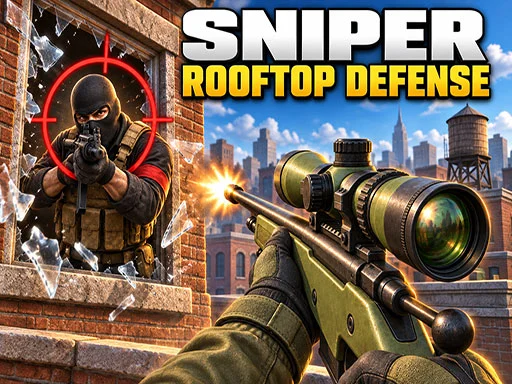
Sniper: Rooftop Defense places the viewpoint above an urban area, where rooftops, approaching threats, cover, projectiles, and aiming cues define the immediate scene. Height expands visibility, but it also makes distance and direction central to every observation.
A scope or central aiming point naturally encourages focus on one region. Before committing to that narrow view, compare the visible rooftops and locate movement across the wider scene. A distant threat can become important while attention remains fixed elsewhere.
Architecture helps organize the scan. Building edges divide the city into readable sections, and differences in height separate one route from another. Returning to these landmarks after checking a target prevents the viewpoint from losing its wider context.
A small figure may be far away, yet its path can reveal whether it is approaching the defended position. Movement across a rooftop carries more information than size alone. Projectile direction and impact feedback then confirm how the exchange develops.
The aiming cue belongs at the center, but it should not hide the object being observed. Roof geometry forms a secondary layer, establishing scale and position. Sky and distant scenery provide atmosphere without competing with active silhouettes.
This order keeps the urban scene readable. The viewer knows where aim is directed, where the target sits in relation to the buildings, and which neighboring regions remain open for another scan.
Sniper: Rooftop Defense is clearest when treated as a problem of observation rather than constant action. Scan the broad field, compare movement with stable architecture, then use the live aiming feedback. The elevated setting turns the city into a visual map of distance and direction.
Visit Sniper: Rooftop Defense for the live game page, then explore Shooting Games for other browser titles involving visible targets.
The title’s economy is important. A limited group of strong cues—roof lines, silhouettes, the viewpoint, and aim—can communicate the encounter without unnecessary interface noise. This article avoids assumptions about missions, weapons, upgrades, or scoring not established by the public page.
When the scene becomes busy, return to three anchors: the nearest roof edge, the center of the aiming area, and the direction of the most visible movement. Together they rebuild the relationship between viewpoint, target region, and urban depth. This is faster than trying to inspect every decorative detail at once.
Contrast should do most of the work. A moving silhouette against a stable wall or sky is easier to track than a figure mixed with effects. After an impact, the screen needs to reveal the result cleanly so the next scan begins from reliable information rather than visual residue.